Quotex Trading Strategies: Top Methods for Consistent Results in 2026
This page is your practical resource for building and applying effective trading strategies on the Quotex platform. Whether you are taking your first steps in binary options or refining an approach that already generates results, you will find structured, actionable guidance here - covering strategy types, indicator setups, risk management, trading psychology, and a step-by-step framework for building a personalised system. Every section is designed to move you from theory to practice as efficiently as possible.
Quotex supports trading across forex pairs, commodities, indices, and cryptocurrencies, with expiry times ranging from under a minute to several days. That flexibility means there is room for multiple strategy types - but it also means that trading without a clear plan is one of the fastest ways to lose capital. The strategies covered below are grounded in established technical analysis principles and adapted specifically for the way Quotex works.
Get the Quotex First Deposit Bonus
Quotex

Trade on Quotex online with bonus and explore a modern digital options platform with fast order execution, flexible strategies and convenient trading tools.
What Is a Quotex Trading Strategy and Why Does It Matter
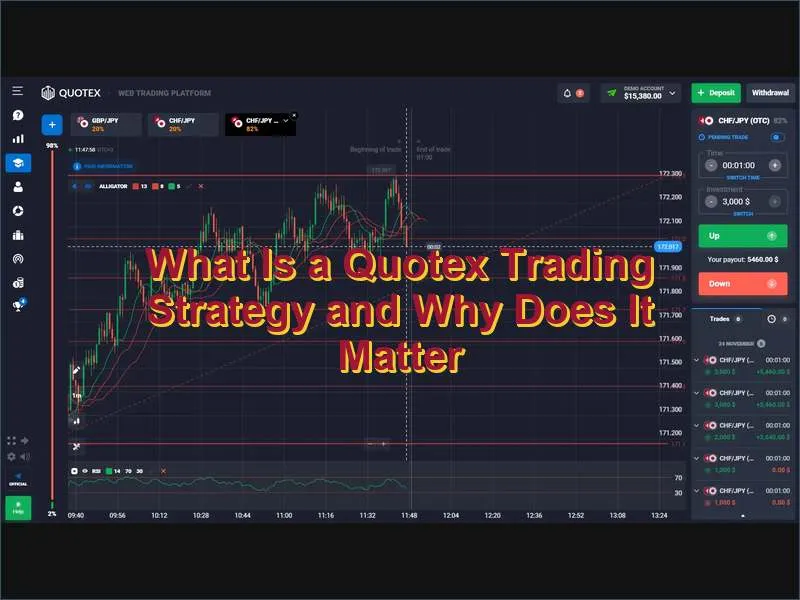
A trading strategy is a defined, repeatable set of rules that tells you when to enter a trade, when to exit, how much to risk, and which assets or conditions to focus on. Without one, every trade becomes an isolated guess rather than part of a consistent process - and consistency is what separates traders who improve from those who stay stuck.
On Quotex, a strategy needs to address three core questions:
- What to trade: Which assets align with your knowledge and the signals your system generates.
- When to trade: Which market sessions, timeframes, and conditions produce the setups your strategy targets.
- How much to risk: What percentage of your balance you allocate per trade, and how you adjust after wins and losses.
Getting clear answers to all three - and writing them down - is the foundation of any approach worth following. If you have not yet created an account, register on Quotex to access the demo environment and start testing without risking real funds.
How Quotex Binary Options Actually Work
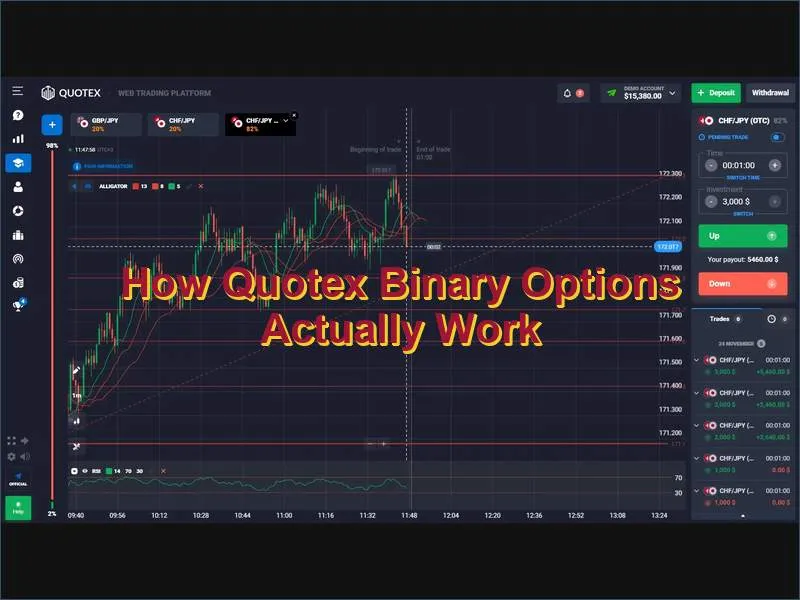
Before selecting a strategy, it is worth being clear about the mechanics of what you are trading. Quotex operates as a digital options platform: you choose an asset, set an expiry time, and predict whether the price will be higher or lower than the current level when the contract expires. If your prediction is correct, you receive a fixed payout - typically between 70% and 95% of the trade amount depending on the asset and conditions. If it is wrong, you lose the amount invested in that trade.
| Platform element | What it means for your strategy |
| Asset selection | Forex, commodities, indices, and crypto - each behaves differently; stick to what you understand |
| Expiry time | From 5 seconds to several days - shorter expiries require faster, more precise setups |
| Strike price | The price level your prediction is measured against at expiry |
| Payout percentage | Varies by asset and market conditions - factor this into your win-rate calculations |
| Demo account | Virtual funds for strategy testing - use it before committing real capital |
One implication often overlooked by new traders: because payouts are fixed and less than 100%, your strategy needs a win rate above a certain threshold just to break even. With an 80% payout, for instance, you need to win more than roughly 56% of trades to be profitable. That raises the bar on signal quality and reinforces the case for disciplined entry criteria. You can explore the platform at no risk using the Quotex demo account.
The Most Effective Quotex Trading Strategies
The strategies below are the most widely used and reliably applicable approaches on Quotex. Each has a distinct logic, a different risk profile, and suits different levels of experience. Most experienced traders use a combination - rather than relying on a single method - because different strategies perform better under different market conditions.
Trend Following Strategy
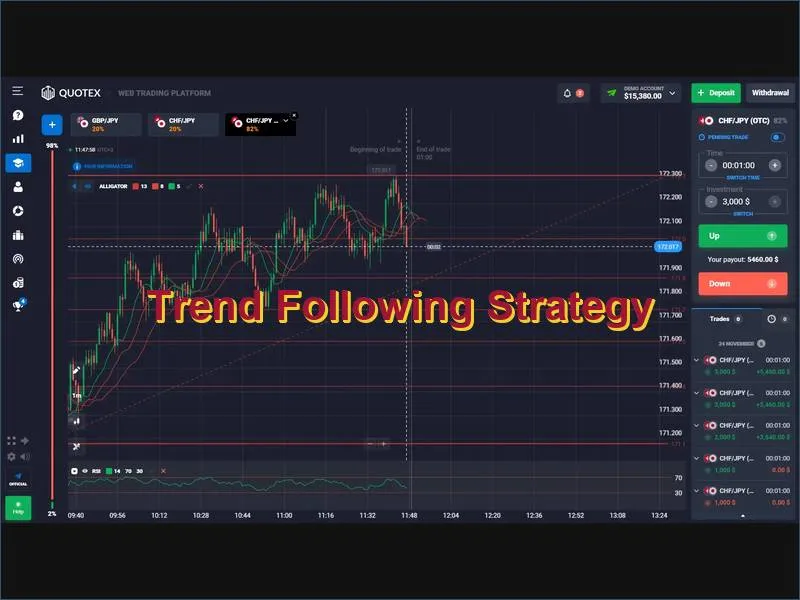
The trend following approach is built on a simple premise: prices that have been moving in one direction are more likely to continue in that direction than to reverse. Your job is to identify the trend and place trades aligned with it, rather than trying to predict turning points.
A practical setup for Quotex:
- Apply a 20-period and a 50-period moving average to your chart.
- When the 20 MA is above the 50 MA and both are rising, the trend is upward - look for Call entries.
- When the 20 MA is below the 50 MA and both are falling, the trend is downward - look for Put entries.
- Use RSI above 50 as a confirming signal for uptrends, below 50 for downtrends.
- Set your expiry to match the chart timeframe - for a 5-minute chart, use a 5 or 10-minute expiry.
This strategy underperforms in sideways or choppy markets, so identifying whether the market is trending before placing a trade is as important as the trade itself. It is the most recommended starting point for anyone new to the platform.
RSI Overbought and Oversold Strategy
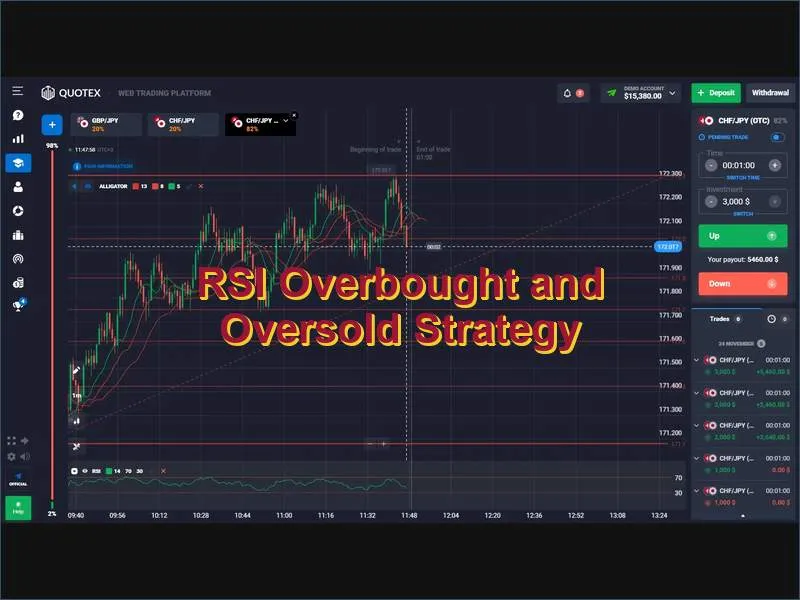
The Relative Strength Index (RSI) measures the speed and magnitude of recent price changes, producing a value between 0 and 100. Readings above 70 suggest the asset may be overbought - and due for a pullback. Readings below 30 suggest it may be oversold - and due for a recovery. These zones are the foundation of the RSI strategy on Quotex.
- Put signal: RSI rises above 70, then crosses back below - price may be turning down.
- Call signal: RSI falls below 30, then crosses back above - price may be turning up.
- Confirmation: Look for a supportive candlestick pattern (e.g. engulfing, pin bar) at the same moment the RSI signal appears.
One important caveat: in strong trends, RSI can remain in overbought or oversold territory for extended periods without a reversal. Always check whether you are trading against the trend before acting on an RSI signal alone.
Breakout Trading Strategy
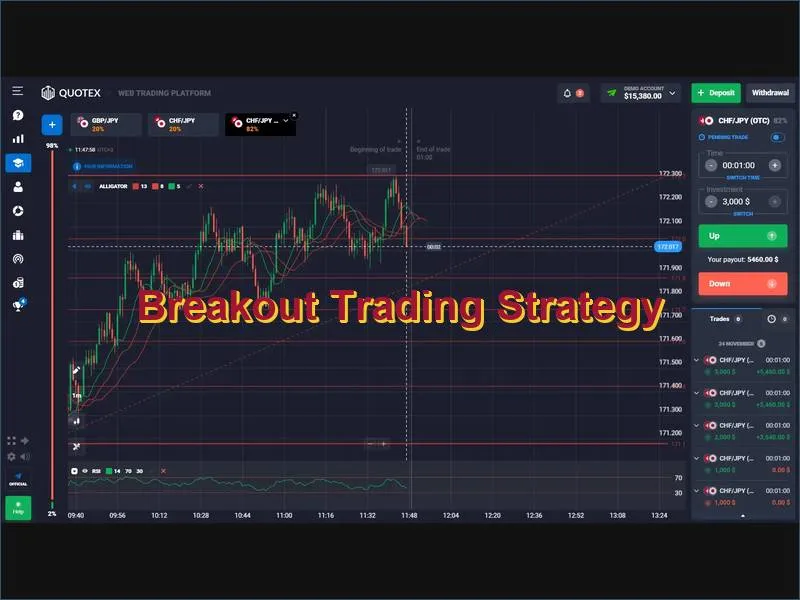
Breakout strategies aim to capture the sharp directional movement that often follows a period of consolidation. When price has been moving within a narrow range and then breaks decisively through a support or resistance level, it frequently continues in that direction - at least long enough to produce a profitable short-term trade.
On Quotex, Bollinger Bands are a useful tool for identifying breakout conditions:
- When the bands narrow significantly, the market is compressing - a breakout is likely approaching.
- When price closes clearly outside the upper band with volume or momentum confirmation, consider a Call.
- When price closes clearly outside the lower band, consider a Put.
- Use a short expiry (equal to the timeframe of the breakout candle) to stay close to the moment of momentum.
The main risk with breakout trading is false breakouts - where price briefly exceeds a level before pulling back sharply. Waiting for a confirmed close outside the level, rather than trading the initial spike, reduces but does not eliminate this risk.
Candlestick Pattern Strategy
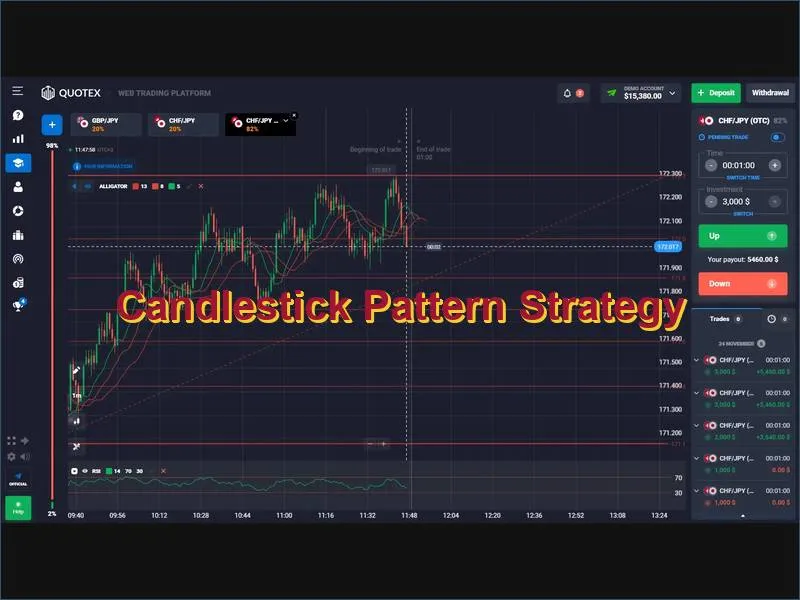
Candlestick patterns encode market psychology directly in the price chart - showing you not just where price has been, but the balance of buying and selling pressure behind each move. Several patterns are particularly relevant for short-expiry binary options trading on Quotex.
| Pattern | Signal type | What it indicates |
| Bullish engulfing | Reversal (bullish) | Large green candle completely engulfs the prior red candle - buyers have taken control |
| Bearish engulfing | Reversal (bearish) | Large red candle engulfs the prior green candle - sellers have taken control |
| Pin bar (hammer / shooting star) | Reversal | Long wick with a small body shows rejection of a price level |
| Doji | Indecision / potential reversal | Open and close nearly equal - market is undecided, often precedes a move |
| Morning / Evening star | Reversal (three candles) | Three-candle pattern signalling a shift in momentum at key levels |
Candlestick patterns are strongest when they appear at meaningful price levels - support, resistance, moving averages, or Fibonacci retracement zones. A pin bar in the middle of a range carries far less weight than one forming precisely at a multi-week support line.
News and Fundamental Analysis Strategy
Major economic events - central bank interest rate decisions, employment reports, inflation data, geopolitical developments - can move currency pairs and other assets sharply within seconds of release. News trading strategies attempt to anticipate or react to these moves.
There are two main approaches:
- Pre-news positioning: You form a view on how the market will react to an upcoming release and enter before the data drops. Higher potential reward, but the market does not always move as expected.
- Reaction trading: You wait for the initial market reaction to confirm the direction, then enter with the momentum. More reliable confirmation, but you sacrifice some of the move.
Use an economic calendar to track upcoming high-impact events. Avoid trading assets closely linked to the release in the 5-15 minutes before the announcement, as spreads widen and volatility can be erratic. Available bonuses on Quotex can supplement your capital while you develop experience with news-driven setups.
The 1-Minute Scalping Strategy (ZigZag + DeMarker)
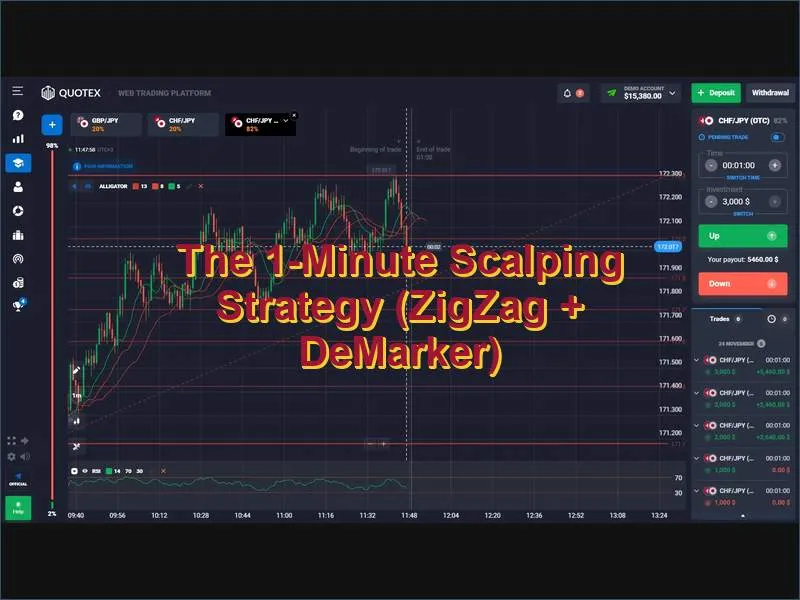
For traders who prefer very short expiry times, a structured scalping setup using the ZigZag indicator and the DeMarker oscillator provides a framework for identifying fast reversals with greater precision than price action alone.
Recommended indicator settings:
- ZigZag: Deviation = 5, Depth = 12, Backstep = 3
- DeMarker: Period = 14, Overbought level = 70, Oversold level = 30
Call entry conditions:
- ZigZag has just completed a downward swing (last pivot is a low).
- A bullish reversal candle (hammer, engulfing) forms at the swing low.
- DeMarker crosses back above 30 from the oversold zone.
Put entry conditions:
- ZigZag has just completed an upward swing (last pivot is a high).
- A bearish reversal candle (shooting star, bearish engulfing) forms at the swing high.
- DeMarker crosses back below 70 from the overbought zone.
This scalping setup works best during active trading sessions on major currency pairs. Avoid applying it during low-liquidity periods or on OTC markets, where price movement can be unpredictable and signals less reliable.
Risk Management: The Foundation of Long-Term Profitability
The most technically sophisticated strategy will fail without disciplined risk management. Capital preservation is not a secondary concern - it is the primary one, especially in the early stages when you are still learning which setups work and which do not.
| Rule | Practical application | Why it matters |
| The 1-2% rule | Never risk more than 1-2% of total account balance per trade | A losing streak of 10 trades still leaves 80-90% of capital intact |
| Daily loss limit | Stop trading when losses reach 5-10% of balance in a single session | Prevents emotional decision-making from compounding losses |
| Asset diversification | Spread trades across different asset classes rather than concentrating on one | Reduces exposure to a single market event or anomaly |
| Risk-reward awareness | Calculate your break-even win rate given the payout percentage before trading an asset | Ensures your strategy is mathematically viable before you risk real money |
| Trade journal | Record every trade: setup, entry reason, outcome, and what you learned | Identifies patterns in your own behaviour that analysis cannot reveal |
Position sizing is the single most controllable variable in trading. Even if your win rate is modest, consistent small positions protect you through losing streaks and give your strategy time to prove itself. Making a deposit on Quotex and starting with smaller trade sizes while you build confidence is always a sound approach.
Technical Indicators Available on Quotex and How to Use Them
Quotex provides an extensive set of built-in technical tools. Rather than using all of them simultaneously, effective traders select two or three that complement each other and apply them consistently.
Moving Averages (MA)
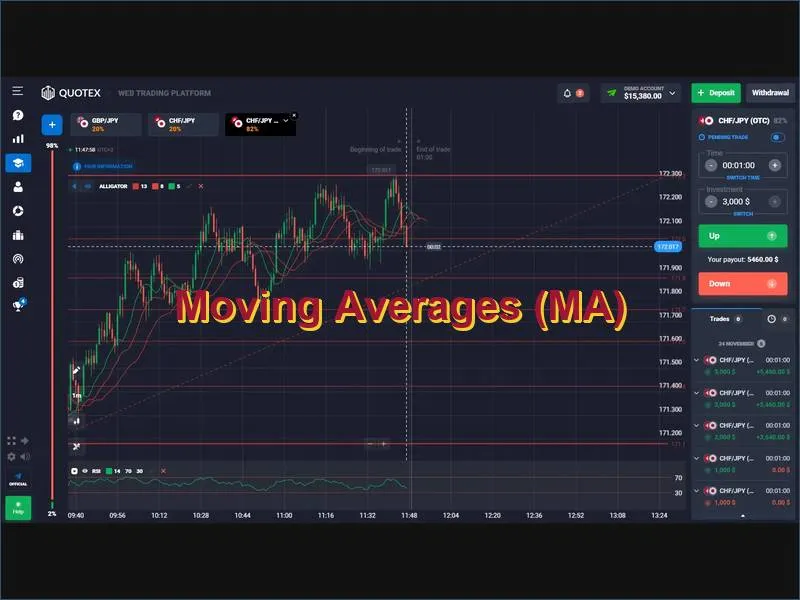
Moving averages smooth out price fluctuations and reveal the underlying trend direction. The most practical application is the crossover method: when a short-period MA crosses above a longer-period MA, momentum is shifting upward; when it crosses below, it is shifting downward. Common settings are 20/50 for medium-term trends and 9/21 for shorter scalping timeframes.
RSI - Relative Strength Index
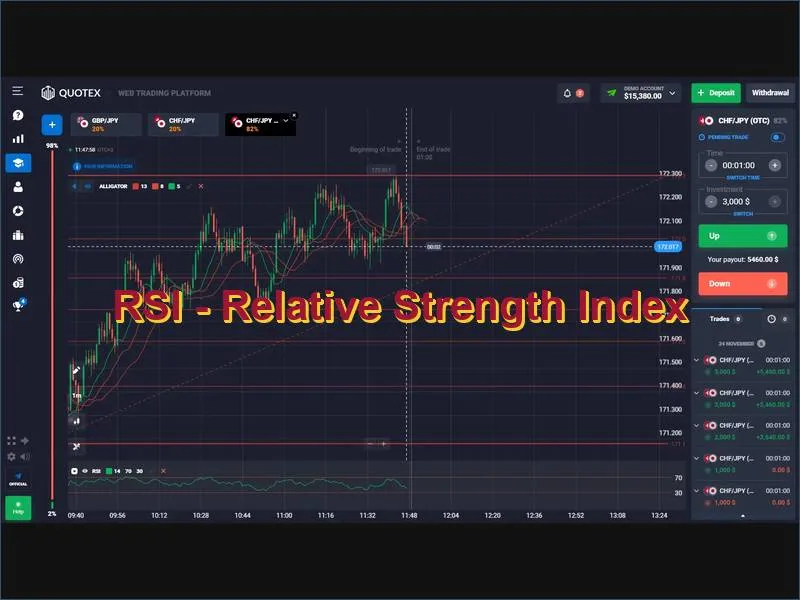
RSI (typically set to a 14-period) oscillates between 0 and 100. The standard overbought level is 70 and the oversold level is 30. For binary options with shorter expiries, some traders tighten these to 75 and 25 to reduce false signals and wait for more extreme conditions before acting.
MACD - Moving Average Convergence Divergence
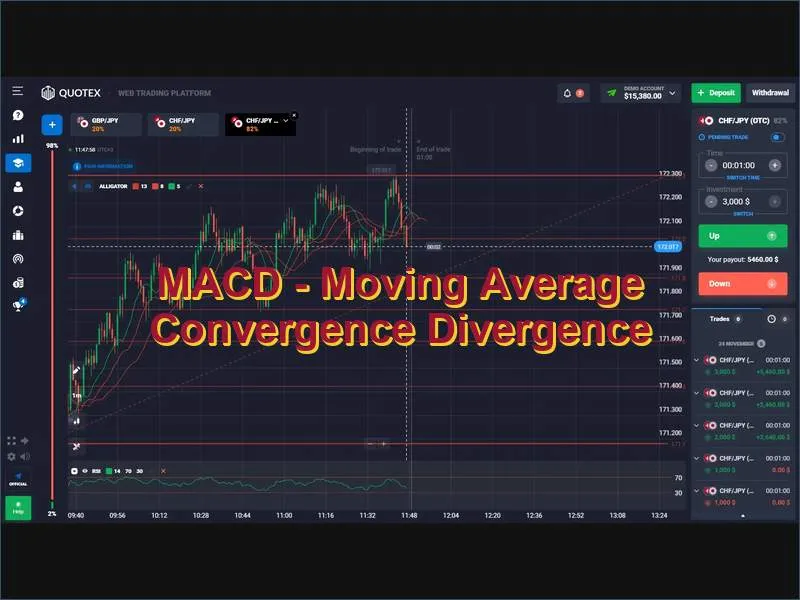
MACD measures the distance between two exponential moving averages and plots it alongside a signal line. When the MACD line crosses above the signal line, it indicates building upward momentum. When it crosses below, downward momentum is strengthening. MACD is most reliable in trending markets and produces more false signals during periods of sideways price action.
Bollinger Bands
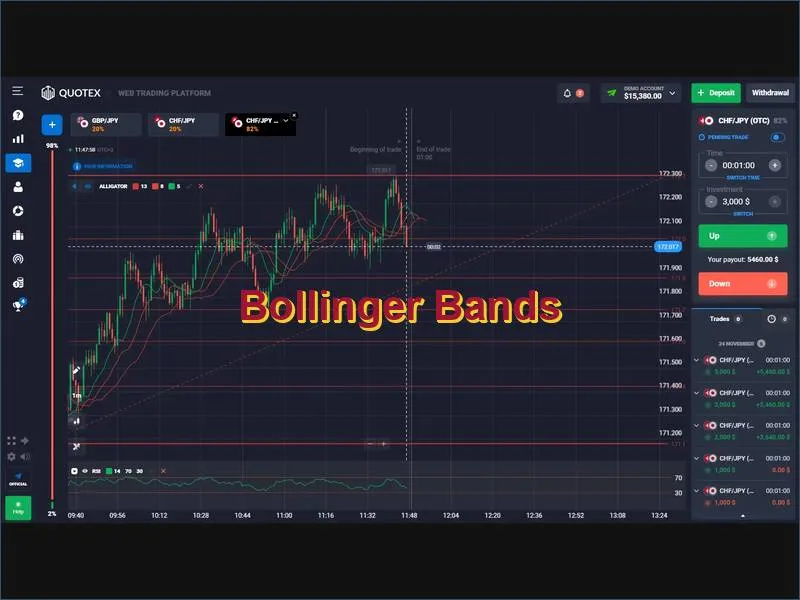
Bollinger Bands consist of a 20-period moving average with two standard deviation bands above and below. They adjust dynamically to volatility: when the bands widen, volatility is increasing; when they narrow (squeeze), a significant move is often imminent. Price touching or closing outside the outer bands can signal either a breakout or - in mean-reversion setups - an overextension likely to correct.
Fibonacci Retracements
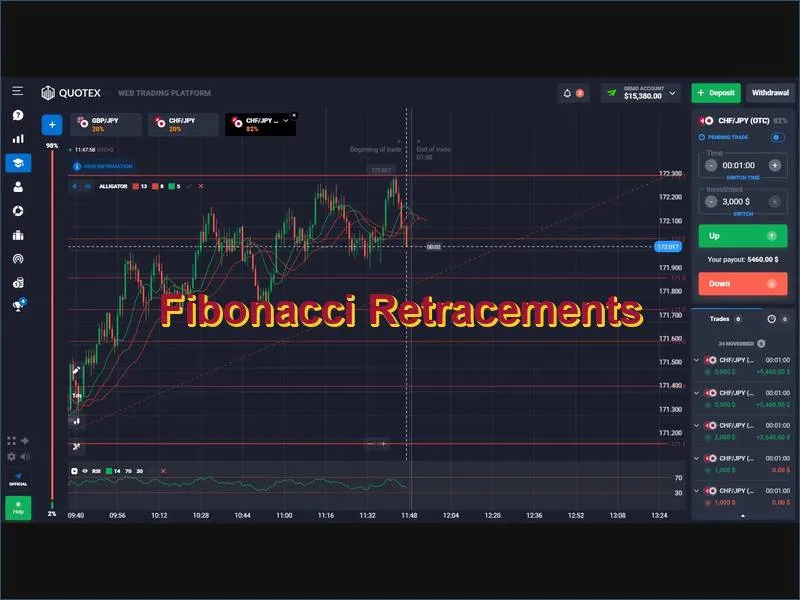
Fibonacci retracement levels (23.6%, 38.2%, 50%, 61.8%, 78.6%) mark zones where price commonly pauses or reverses after a significant move. They are most useful for identifying potential entry points when a trend pulls back before continuing. The 61.8% level - known as the golden ratio - is widely watched by traders and frequently acts as a decision zone.
Trading Psychology: The Mental Side of Consistent Performance
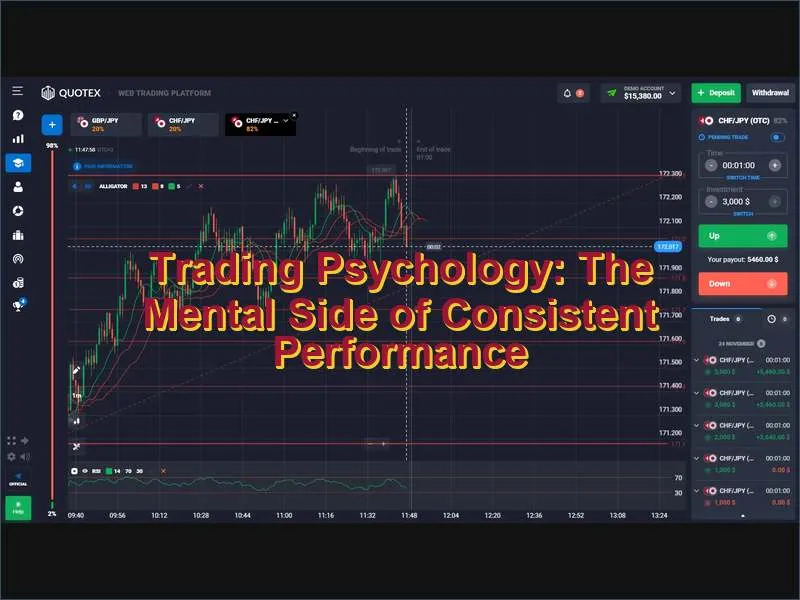
No strategy produces results on its own. Your ability to execute it the same way, trade after trade, under conditions of uncertainty and occasional loss, is what determines whether the strategy's edge actually materialises in your account. The psychological demands of trading are as real as the technical ones.
- Emotional neutrality: A losing trade is data, not a verdict on your competence. A winning trade is not confirmation that you should increase your size. Evaluate both based on process.
- Patience: Waiting for setups that meet all your criteria - rather than forcing trades to stay active - is one of the most underrated skills in trading.
- Avoiding revenge trading: After a loss, the impulse to immediately recoup with a larger trade is one of the most common and damaging patterns. Recognise it as an emotional reaction, not a rational decision.
- Bias awareness: Overconfidence after a winning run and excessive caution after losses are both forms of cognitive distortion. A fixed rule set mitigates both.
- Adaptability within structure: Markets change. A strategy that worked well in trending conditions may need modification during periods of high volatility or sideways movement. Adapt the parameters - do not abandon the process.
Keeping a trade journal - recording your reasoning before each trade and reviewing outcomes weekly - is the most practical tool for developing self-awareness as a trader. Over time, it reveals the patterns in your own decision-making that no indicator can show you.
How to Build a Personalised Quotex Trading Strategy
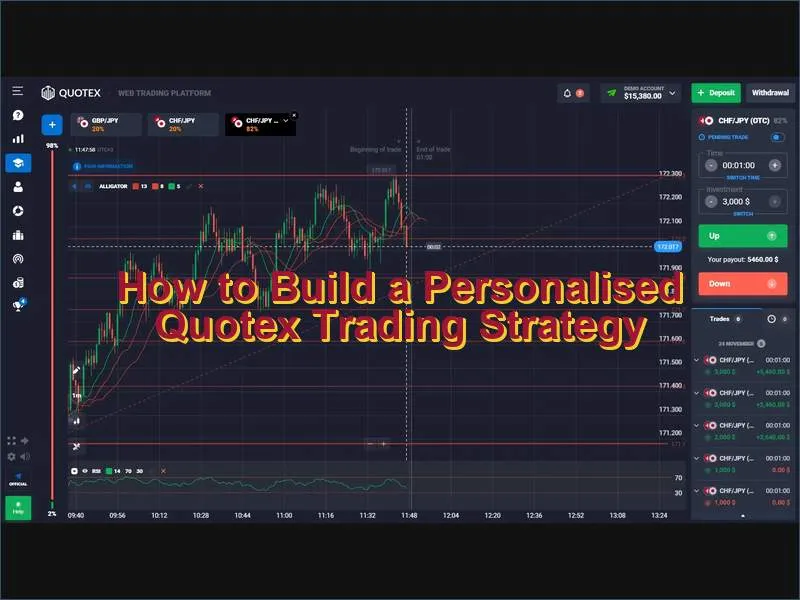
The most effective strategy is not the one with the most complexity or the highest theoretical win rate - it is the one you can execute consistently, that suits your schedule and risk tolerance, and that you understand well enough to adapt when conditions change. Here is a practical framework for building one:
- Define your objective: Are you testing whether trading suits you, supplementing income, or pursuing serious capital growth? Each goal implies a different position size and time commitment.
- Choose your timeframe: If you have 30 minutes per day, intraday scalping is not practical. Match your available time to your chart timeframe.
- Select one primary strategy: Start with trend following or RSI reversals. Master one approach before adding layers of complexity.
- Choose two complementary indicators: One trend indicator (moving average or MACD) and one momentum or volatility indicator (RSI or Bollinger Bands) is a functional starting combination.
- Write your entry and exit rules: Be specific. Not just "RSI is low" but "RSI crosses back above 30 after falling below 28, with a bullish candle on the 5-minute chart."
- Test on the demo account: Run your rules on the Quotex demo for at least two to four weeks before using real capital. Track every trade.
- Evaluate and refine: After your testing period, review win rate, average gain versus average loss, and conditions where the strategy failed. Adjust one variable at a time.
- Apply to live trading with small positions: Begin with the minimum position size. Real-money conditions affect decision-making in ways a demo cannot fully replicate.
If you are ready to move from demo to live trading, you can create a Quotex account and make your first deposit. The platform also offers promo codes that may provide additional trading capital when you start. For mobile-first traders, the Quotex app gives you access to all charting tools and strategy execution on any device.
Comparing Quotex Strategies at a Glance
| Strategy | Best for | Key indicators | Main strength | Main limitation |
| Trend following | Beginners | Moving averages, RSI | Simple rules, aligned with momentum | Ineffective in ranging markets |
| RSI reversals | All levels | RSI, candlestick patterns | Clear entry signals in consolidating markets | False signals in strong trends |
| Breakout trading | Intermediate | Bollinger Bands, support/resistance | Captures sharp directional moves | Vulnerable to false breakouts |
| Candlestick patterns | Intermediate to advanced | Price action, key levels | Directly reads market sentiment | Requires experience to read reliably |
| News trading | Informed traders | Economic calendar, momentum | Captures high-volatility moves | Unpredictable short-term reactions |
| 1-min scalping (ZigZag + DeMarker) | Active short-term traders | ZigZag, DeMarker | Structured reversal signals at speed | Requires fast execution and focus |
Is Binary Options Trading on Quotex Risky?
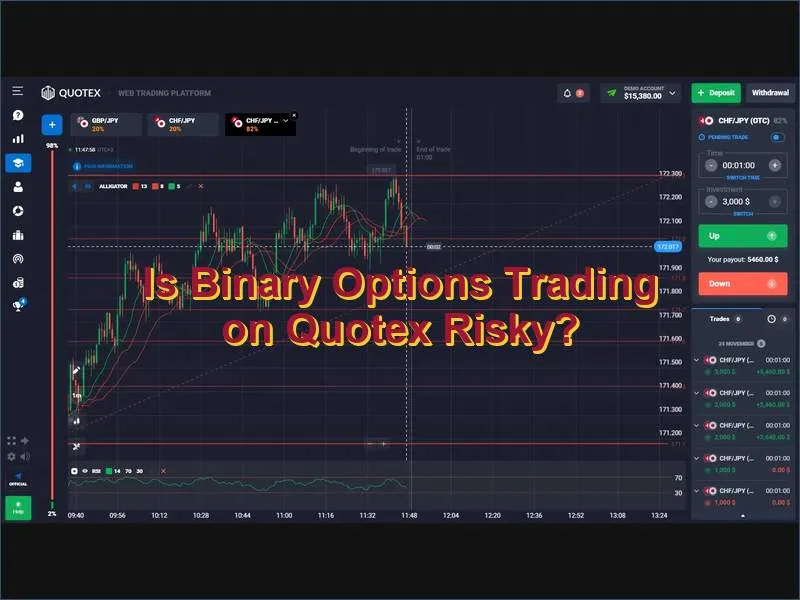
Binary options trading carries genuine financial risk. The fixed-loss structure of each contract means that a poor strategy or undisciplined execution will deplete capital quickly. Several specific risks are worth understanding clearly:
- Mathematical disadvantage: Because payouts are typically less than 100% of the trade amount, you need a win rate above 50% just to break even - often above 55-60% depending on the specific payout.
- Overtrading: The speed of binary options makes it easy to place far more trades than any strategy can justify. More trades without quality criteria is a reliable way to lose capital faster.
- Emotional decision-making: Short expiry times and fast outcomes create a feedback loop that can drive impulsive behaviour. A rules-based strategy is the most direct counter to this.
- Market unpredictability: No strategy produces 100% accuracy. External events - sudden geopolitical news, central bank surprises - can invalidate technically sound setups.
None of these risks make Quotex unsuitable for trading. They do mean that treating it as a casino - or expecting immediate profits without preparation - will produce predictable losses. Approach it as a skill that takes time to develop, use the demo account extensively, and only trade with capital you can afford to lose. You can also review an independent assessment of the platform in our Quotex review. If you already have an account, log in to Quotex to access all platform features and your trading history.
Frequently Asked Questions About Quotex Trading Strategies
What is the most beginner-friendly trading strategy on Quotex?
How much of my balance should I risk on a single trade?
Can I test a Quotex strategy without depositing real money?
How often should I review and adjust my trading strategy?
Which assets work best for short-term strategies on Quotex?
Is it possible to use multiple strategies on Quotex at the same time?
What makes a Quotex strategy stop working and how should I respond?
Quotex